Market Insights Recap — Week of April 6, 2026
Video
Hello, I'm Steve Orr, Chief Investment Officer for Texas Capital's Private Bank.
Well, we've had an interesting journey this last few weeks in the markets, and it's always a good time to make sure you have your lessons, rules and a little bit of math thrown in. So, this is going to be a fun video. Short, but fun.
Now, we talk a lot about separating signals from the noise and just tuning out the noise. Lesson one: Pay attention to the tape, not the noise. Lesson two: The trend is your friend, so don't fight the tape. Lesson three: Retail thinks about market timing; professionals think about position sizing. So, there are rules also for investing. Lessons you learn the hard way, rules you implement after the lessons.
Now one of my favorites is rule number four: Be able to spot the change of the change. That's the second derivative for you calculus folks. Is the rate of change in a trend slowing or speeding up? Is the rate of change in jobless claims increasing or decreasing? These signals factor into your investing process because investing is a manufacturing process. You build a consistent, repeatable framework for producing returns.
As a professional investor, that means our goal is to exceed our clients expectations and benchmarks. Being able to spot changes in the change is key. Now, we're going to come back to lessons and rules with some real life and sometimes painful examples in future videos.
But, for now, I'm going to leave you with some math problems. Our base case for the economy and markets remains unchanged for now. The news noise around the war is going to continue to yank markets back and forth over the next few weeks. Iran has learned that they have the luxury of time, while the West perceives that it does not. So remember, right now the primary trend for stocks is higher. Employment is steady, if not strong, and earnings are rising. Those underpin the long-term secular bull.
Now, if the economy weakens, here's our low case. So, get ready for some math. Two and a half to 3.5 becomes 2 to 4. What do I mean there? Well, we thought coming into this year, inflation would bottom around 2.5%. It reached a low of 2.4 a couple of months back. And then it would rise through the year, 3.5. Well, the oil shock, aluminum, helium, fertilizer, all those other outputs of petroleum being either delayed or shut in for some period of time this year. Just even if the world stops right now, 2.5 becomes 4% inflation. Get ready.
Now, 2 to 3 becomes 2 to 2. Our economy grew around 2, 2.5% last year depending on how you measure it. And we thought that would rise to 3 comfortably this year, even exceed 3% in the second half of the year, thanks to a lot of the policy decisions and the One Big Beautiful Bill. Now, low case, we just are flat. We grew at 2.4%, 2.2%, somewhere in there last year. Same for this year.
Finally, we're very hopeful that 3 to 1 still stays 3 to 1. So, of the five major wars, three of them right now are kinetic, you know, with people throwing stuff at each other. And we still hope those come down to just one or maybe none this year.
So, our short-term indicators: largely neutral. Our long-term indicators: still green. So stay patient; 'til next time.
Connect with an expert banker.
Experience more with skilled bankers who are committed to helping you grow.
Additional Insights
Economy
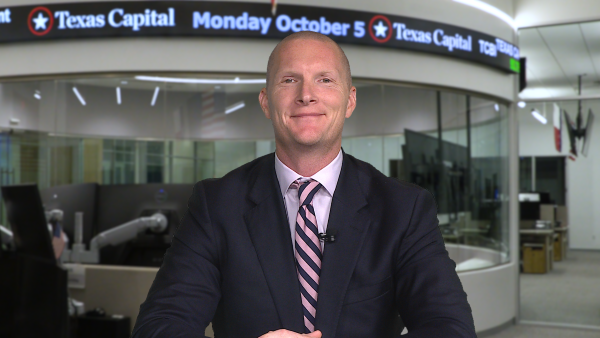
Investment Insights — Week of October 5, 2026
<p>Watch the Investment Insights video for the week of October 5, 2026, from our expert, Tim Gereg.</p>
Economy
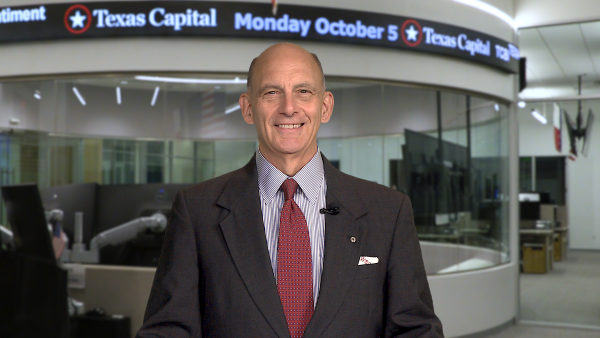
Market Insights Recap — Week of October 5, 2026
<p>Watch the Market Insights video for the week of October 5, 2026, from our expert, Steve Orr.</p>

Economy
Market Insights Recap — Week of September 28, 2026
<p>Watch the Market Insights video for the week of September 28, 2026, from our expert, Steve Orr.</p>